August 17, 2026





August 17, 2026
MOUNT KUN
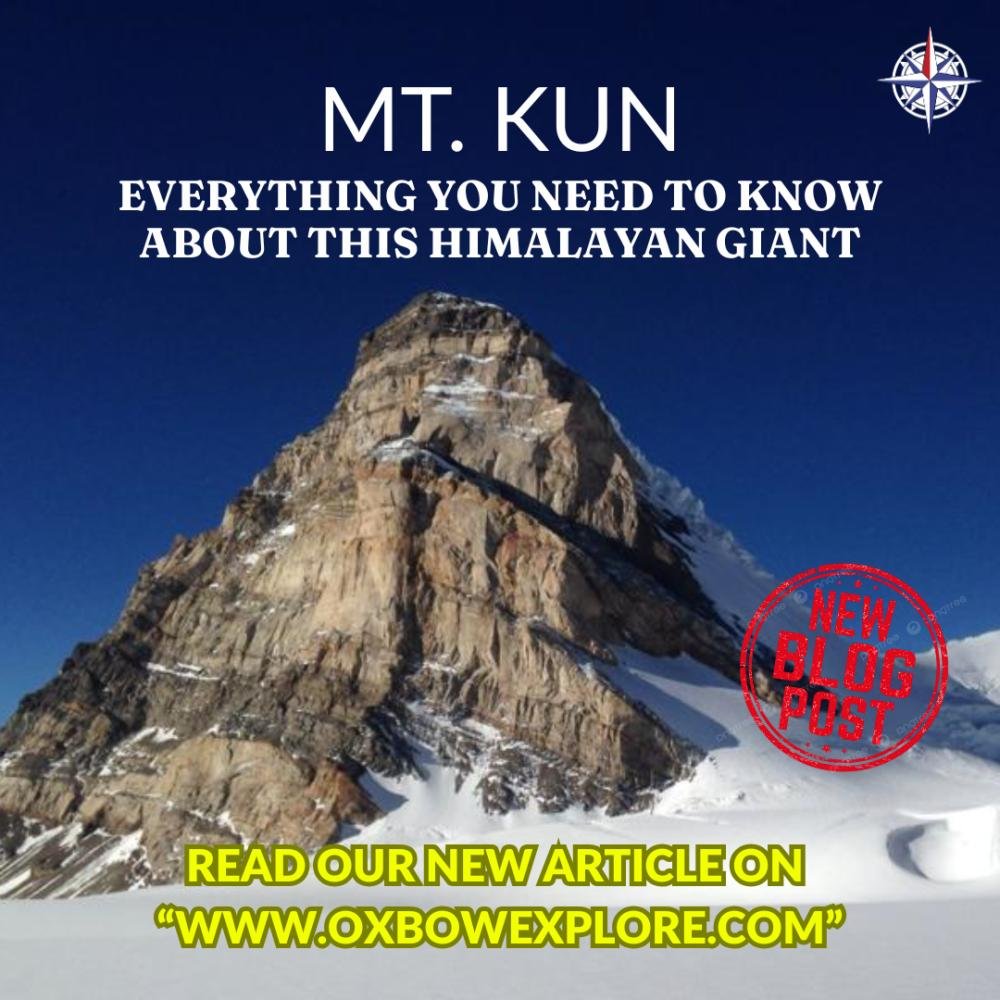
MOUNT KUN: EVERYTHING YOU NEED TO KNOW ABOUT THIS HIMALAYAN GIANT
“Some mountains challenge the climber; others challenge the imagination. Mount Kun does both.”
High in the rugged landscape of Ladakh, where deep valleys meet enormous walls of rock and ice, stands Mount Kun—one of the remarkable high peaks of the Himalayan region. Rising to approximately 7,077 metres (23,212 feet), Kun is far more than a number on an elevation chart. It is part of a dramatic landscape shaped by glaciers, snowfields, steep ridges, and centuries of natural forces.
But the story of Mount Kun becomes even more fascinating when we look beyond the summit—to its neighboring peak, Mount Nun, and the spectacular Nun–Kun massif.
Where Mount Kun Begins Its Story…
Mount Kun is located in the Suru Valley region of Ladakh, surrounded by some of the most dramatic high-altitude landscapes in the region. The journey towards the mountain takes travelers through a world of rugged valleys, remote settlements, glaciers, and towering Himalayan peaks.
As the landscape rises, the familiar world gradually disappears. The air becomes thinner, the temperatures colder, and the mountains increasingly dominate the horizon.
Understanding Nun and the Nun–Kun Massif
Before understanding Kun, it is important to understand Mount Nun. Nun is the higher of the two principal peaks, while Kun stands as its neighboring summit. Together, they form the famous Nun–Kun massif.
Although Nun and Kun are closely associated, they are distinct mountains with their own geographical and mountaineering characteristics. Their presence together gives the region a unique identity.
Mt. Kun vs. Mt. Nun: Which One Should You Opt For?
· Altitude Difference: The height difference is minimal—Mt. Nun stands at 7,135 m, while Mt. Kun is 7,077 m, making them only about 60 meters apart.
· Technical Difficulty: Both peaks demand advanced mountaineering skills, physical fitness, and strong acclimatization.
· Route Characteristics: Mt. Nun involves exposed ridges and a challenging summit push, while Mt. Kun has a more defined technical section between Camp 1 and Camp 2.
· Risk Factor: Both expeditions carry comparable high-altitude risks, which can vary with weather, snow, and route conditions.
· Choose Mt. Nun if you want to climb one of India’s highest peaks, enjoy exposed ridge climbing, and aim for a prestigious 7,000 m+ summit.
· Choose Mt. Kun if: You are looking for a technically engaging climb, want to progress toward higher-altitude expeditions, and prefer a route with a defined technical crux.
· Experience Required: Neither peak should be considered an “easy” option. Both are serious 7,000m-class expeditions and are best suited to experienced climbers with prior 6,000m+ mountaineering experience.
The Legacy Behind Mount Kun
Mt. Kun was successfully summited in 1953 by a Swiss-French-Indian team led by Bernard Pierre. However, the mountain was first climbed much earlier, in 1913, by an Italian expedition led by Mario Piacenza. This early ascent marked an important milestone in the history of Himalayan mountaineering.
A Mountain Shaped by Rock and Ice
Mount Kun rises from a landscape where rock and ice dominate the higher elevations. Glaciers, snowfields, steep ridges, and deep valleys create a constantly changing environment.
From the lower valleys, the mountain can appear distant and almost unreachable. As the landscape rises towards the higher elevations, however, the scale of the mountain becomes increasingly apparent.
It is this combination of rugged terrain and frozen landscapes that gives Kun much of its visual character.
What Makes Mount Kun Unique?
Mount Kun's uniqueness is not simply its elevation. Several characteristics come together to create its identity:
- High-Altitude Landscape—Its elevation places it in an extreme Himalayan environment of snow, ice, and rock.
- Connection with Mount Nun—Its relationship with Nun gives the mountain a distinctive place within the Nun–Kun massif.
- Glaciers and Snowfields—The surrounding frozen landscape contributes to the mountain's dramatic appearance.
- Remote Setting—Its location in the Suru Valley adds a sense of remoteness and discovery.
- Mountaineering Heritage – Kun has an important place in the history of high-altitude mountaineering in the region.
Mount Kun and Himalayan Mountaineering
For mountaineers, Mount Kun represents more than a high summit. Its elevation, steep terrain, glaciers, weather, and remote setting create an environment that demands preparation, technical ability, endurance, and respect for nature.
The mountain has therefore become part of the broader story of Himalayan exploration and mountaineering.
The Landscape Beyond the Summit
Perhaps one of the most fascinating aspects of Mount Kun is that its story does not end at the summit.
The surrounding Suru Valley, glaciers, neighbouring peaks, and remote mountain settlements create a much larger landscape to explore. Every ridge appears to lead towards another horizon, while the changing light across the mountains constantly transforms the scenery.
Why Mount Kun Continues to Fascinate
Mount Kun brings together several elements that make the Himalayas extraordinary:
- Extreme altitude
- Dramatic glaciers and snowfields
- Rugged mountain terrain
- Remote valleys
- A fascinating connection with Mount Nun
- A rich mountaineering heritage
Together, these characteristics make Kun much more than another Himalayan peak.
A Mountain Worth Discovering
Mount Kun represents the spirit of Himalayan exploration—the desire to travel beyond familiar landscapes and discover what lies behind the next ridge. Its combination of natural beauty, geography, altitude, and mountaineering history continues to capture the imagination of people fascinated by the mountains.
And perhaps that is what makes Kun truly remarkable. You can measure its height in meters, study its geography on a map, and describe its glaciers in words—but the full character of the mountain can only be understood by experiencing the vast landscape that surrounds it.
More Than Just a Mountain
Mount Kun is not simply a 7,077-meter peak in Ladakh. It is part of a larger Himalayan story—a story of rock and ice, Nun and Kun, valleys and glaciers, exploration and endurance.
For those who look beyond the numbers, Mount Kun offers something even more powerful: the feeling that there is always another ridge to cross, another horizon to discover, and another Himalayan story waiting to be told.
Latest Articles
MOUNT KUN

HOW BORDER TOURISM IS OPENING NEW ROUTES FOR MOUNTAINEERS
January 6, 2026

UNCLIMBED PEAKS OF INDIA: THE NEXT FRONTIER IN EXPLORATION
December 2, 2025

THE ANATOMY OF ENDURANCE
October 23, 2025

THE PSYCHOLOGY OF THE SUMMIT: WHAT CLIMBING TEACHES YOU ABOUT LIFE
October 15, 2025
